Saturday, November 18, 2023

Do People Care about Movie Ratings Anymore? (Part 1)

While writing my Super 8 review I grappled with whether or not the Netflix series Stranger Things was more or less violent/gruesome than the film I was reviewing, and therefore whether or not I would recommend Super 8 to a younger viewer if their parents thought Stranger Things was too violent. But, would a parent really care? It was at that moment I started thinking about how different the landscape of film and television is today compared to what it was two or three decades ago in terms of how we consider what is appropriate for people who are not yet adults. The way people can access media has changed so drastically, and there are now so many possibilities, how do we even keep up with what the ratings system suggests? When I say ratings I don’t mean reviews, I mean the guidelines set for each film and TV program about which audiences should or should not be watching. In 2023, does a show or movie’s rating carry the same impact it once did?

Film ratings have always been a point of contention for many people. Some parents are very strict about following them, while others are more lackadaisical about what their kids can watch. Ever since the beginning of cinema there have been rules about what is allowed to be shown on film, and filmmakers have been pushing the boundaries for decades, but the rating systems that have tried so hard for so long to categorize what we watch may be no match for modern technology. Let’s go back to where these rating systems first came from so we can understand how they have shaped the way a movie or show is rated today.


From Pre-Code Hollywood (1927-1934) to the Days of the Hays Code (1934-1968)


There was a brief time when Hollywood films were not being censored very consistently, which meant some filmmakers got away with things that many people viewed as problematic at the time. This isn’t to say censors didn’t exist or that films were released without any consequences. In the early days of motion pictures with sound (remember, it was a new thing to be able to see and hear a movie in the late 20’s/early 30’s) many filmmakers ignored the censors, and censors eventually put forward a code that was kind of like the pirate code: they were more like “guidelines” than actual rules everyone had to follow. Guidelines included “Don'ts” and “Be Careful's” but some of the other authoritarians of whether a film was accepted or not included local laws and even popular opinion.

Push came to shove when the Catholic Church stepped in and started protesting in the early 30’s, calling cinema immoral, so that was when filmmakers could no longer just ignore the guidelines—they became definite rules after that. There was no such thing yet as a restriction on who could see any given film in a movie theater. Kids still usually went with their parents to the cinema, but anyone could go see anything that was playing if they could afford admission or sneak in without getting caught. The Motion Picture Production Code, otherwise known as the Hays Code after Motion Picture Producers and Distributors of America (MPPDA) president Will H. Hays, went into full effect in 1934 and there was a shift in the content of films, though it might be tough for modern audiences to identify what the do’s and don’ts were because we are so desensitized by today’s standards. Every movie had to be approved by them, or else the producer could be fined and the film could not be legally shown in an American cinema.

Films from the pre-code era were often re-released numerous times over the years long after their initial premieres, but many of them were not the same once the censors cracked down. If you watch the original King Kong (1933) today, you’ll find the uncut version that runs about 100 minutes and has such violent moments as people being eaten by dinosaurs and getting stepped on by the giant ape, and that was the version people saw when it first premiered, but subsequent releases couldn’t get past more rigorous censorship. If you watched King Kong in the 1940’s or 1950’s, scenes like the Brontosaurus eating the guy in the tree or Kong putting a native in his jaws were either trimmed or cut out completely.

Frankenstein (1931) had been even more controversial a couple years before Kong, and suffered from even worse censoring in at least one state. The scene of The Monster throwing the little girl in the lake was cut completely and didn’t get restored until the 1980’s. The state of Kansas was so appalled by the movie they demanded to have 32 scenes cut if it were to be shown—that would mean cutting half the runtime, and the complete runtime was only 70 minutes to begin with! Speaking of Boris Karloff and Universal monster movies, one last clear example of how things had changed since Pre-Code is when you compare The Mummy (1932) with The Mummy’s Hand (1940). In a flashback in The Mummy you see a man impaled by a spear—that was quite violent and gruesome for back then. The Mummy’s Hand repurposes nearly all of the same footage for a new flashback, but the one impaling shot was noticeably left out.

For over three decades the code dictated what was OK to show to audiences and what was not OK, but it’s glaringly obvious looking at it from a modern perspective that most of those rules would not fly today. You could not depict homosexual relations at all on screen. In fact, if you depicted any kind of relationship that wasn’t what was considered a healthy, happy, normal relationship at that time, it was not likely to be shown in a theater at all. The Catholic influence on the code was kept under wraps in the early days of the code, but it’s pretty clear to look back on it now and see why some of the rules existed. The Production Code Administration was created so Hollywood could self-regulate censorship and avoid involving government censorship, and nearly every Hollywood film produced after 1934 adhered to the code.

In the 1950’s Hollywood was pressured to change. The pressures came from multiple factors, including the birth of television, which now gave people a way to watch stuff at home and not need to go to the movie theaters, the increase in foreign films, which did not need to adhere to the American Hays Code, and a shift in post-war culture that showed, just like Bob Dylan sang about, “The Times They Are A-Changin’”. Adjustments were made to the code as certain subjects that had previously been taboo were re-evaluated. For example, prostitution was something you might see in a pre-code movie, but not something made in the early 1940’s, and after 1956 the code allowed for it to be depicted again. Filmmakers and producers were constantly challenging what was possible in film, and eventually the Hays Code gave way to a new system that is still around today.

Next time, we’ll look at what replaced the old system of censorship and where this idea of “rating” a movie first began.


Friday, November 10, 2023

Gamera Rebirth: Anime Series Review


GAMERA -Rebirth- : Anime Series Review


What a time to be a fan of giant monsters! Godzilla vs. Kong finally came out in 2021 just prior to movie theaters reopening after being closed for over a year due to the pandemic, and it was a triumphant rematch between the king of the monsters and the eighth wonder of the world. Then, Godzilla made his anime debut in episodic format in his native Japan with Godzilla Singular Point, as did Kong in the Monsterverse-tie-in series Skull Island at the start of this summer. Now, I can report that the good old friend of all children Gamera is alive and well in 2023, also making his anime debut in the six-part series Gamera Rebirth, which came out on Netflix in September. It’s been a busy couple of months for me, but I’ve finally finished the series and can share my thoughts.  

Not only is this the first Gamera TV show, it’s the first Gamera anything since 2006! Technically, the last time the giant atomic mutant turtle was making waves was back in 2015 when a short test film was released as a proof-of-concept for starting a new Gamera film series, and while it was an exciting tease of the possibilities with modern CGI technology, it was essentially a glorified trailer for a film that never came to fruition. I would still like to see Gamera come back to cinemas, but for now, I’m pretty satisfied with his rebirth as it is. Unlike Godzilla Singular Point, which I found to be a disappointing series that prioritized uninteresting characters and dull discussions of pseudoscience over engaging episodic storytelling and interesting new ways of using classic Godzilla monsters, I’m very happy to say Gamera Rebirth gets everything (mostly) right that Singular Point did not.

My favourite part of the Godzilla anime was the opening titles because of the hyperkinetic song “In Case…” by BiSH. The Gamera anime has a similarly high-energy opening with a song that got me just about as hyped as “In Case…” but there were moments in multiple episodes that I found lived up to the hype of the opening, which I could not say about Godzilla Singular Point. One thing that was both helpful and a hindrance to Gamera Rebirth was not spreading the story so thin over so many episodes. On the one helpful hand, it didn’t feel like a chore to get through all the episodes the way it did with Singular Point, and the story was much more concise, with each episode feeling satisfying on its own while still making me want to keep watching. On the other hindrance hand, though, it made me wish the series had just been condensed down to a movie or even a trilogy of movies, because the 40-minute episodes felt a bit too long at times and started to seem formulaic before I reached the final one.

As I suspected before I knew anything about the show, this is a story about kids, which won’t surprise any Gamera fans because for the majority of the giant turtle’s cinematic history Gamera films have been mostly aimed at younger audiences. In the very first episode a character drops some profanity, which really caught me off guard. I was taken aback to discover that Gamera Rebirth somehow remains true to the traditional Gamera stories being about kids, but goes harder than Gamera has ever gone before. Maybe they could get away with it because it was produced for Netflix or is in animation, but the show has some of the most violent moments ever seen in the Gamera franchise, and not just monster violence and gore, but people being killed, too. The swearing happens throughout every episode, but it’s not overly gratuitous or excessive. I wouldn’t say it’s a show for kids, but I would recommend it to viewers not already familiar with Gamera. You do not need to be a fan to get it and enjoy it.  

Boco, Joe, and Junichi are three unlikely friends who end up having an adventure they never could have predicted in the summer of 1989. Evil kaiju start showing up in Japan and are destroyed by a giant turtle the kids call Gamera, and Gamera’s arrival changes everything for them. A military brat nicknamed Brody starts out as a bully toward the trio but ends up becoming their new friend, but it isn’t the usual annoying cliché version of an antagonist turning into a protagonist. Brody is given enough development and likability that his transition from bully to friend is acceptable. The kids are recruited by an agent, Mr. Tazaki, and a strange scientist, Dr. Emiko, and something I liked was how the writers came up with a way to get the kids involved with the primary monster plot that was semi-original and not completely stupid. The fact that they are kids tied up in a military/government operation isn’t forgotten, and it’s revealed later in the series why the kids have a direct connection to what’s going on with the monsters that’s new and makes enough sense to buy into—for a story about a giant flying turtle, anyway.

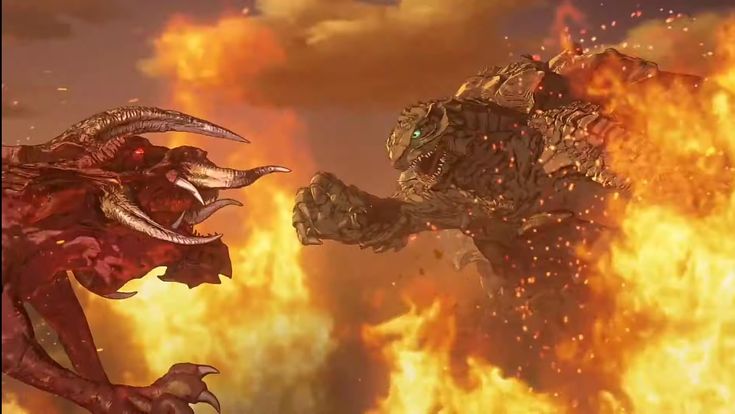
The formulaic nature started to become apparent when I realized the bulk of each episode would be about the human characters, which isn’t all bad, because the characters are fairly likable, and certainly a step above most youthful protagonists of past Gamera stories, and the end of the episode has Gamera fight an enemy monster with awesome heavy metal music playing in the background. There are no new monsters in the series, but the redesigns of Gyaos, Jiger, Zigra, Guiron, and Viras are all top notch, and all of them are able to be more dynamic and fiercer than ever before. The animation allows for action beyond anything that was possible back in the 1960s with men in suits, but the human animation, unfortunately, is one of the show’s weakest aspects. Godzilla Singular Point may have lacked a compelling narrative, but at least it looked good, with an appealing aesthetic and effective 3D animation. Gamera Rebirth has artificial-looking 3D characters moving choppily amid uninteresting backdrops, and definitely made me wish even more that the show had been made in live-action.

Gamera Rebirth was not the reboot to the Gamera franchise that I had expected, but I mean that mostly in a good way. It’s been too long since a new Gamera adventure, so I’m just glad he’s been brought back in a show that feels worthy of what came before and modernizes the classic monster in a pretty effective way, despite telling a story set in the 80’s. I suspect the time period, the characters, and the coarse language/violence are all a byproduct of the success of Stranger Things (this is Netflix, don’t forget), but I don’t think audiences who love that show will love Gamera Rebirth just because it bears some of those similarities. It’s less crazy than the retro Gamera movies and not the same kind of unwieldly sci-fi scramble that Godzilla Singular Point was, but it still left me wishing for more Gamera action. I appreciate that the show feels like it was made for older Gamera fans in many ways, and if you’re a monster movie/show fan, I would recommend checking it out.

I don’t know if there will be a second season (the possibility is left wide open), but I hope Gamera comes back in a movie soon and this show paves the way for that to happen. As of writing this, the Apple TV MonsterVerse series Monarch: Legacy of Monsters is starting in less than a week, Godzilla Minus One comes out in North America next month, and the Godzilla vs. Kong sequel, Godzilla x Kong: The New Empire comes out early next year. Like I said in the intro, this is an amazing time to be a giant monster fan. Even though I don’t love anime, or love how everything is being stretched into episodic storytelling these days, Gamera Rebirth was a surprisingly entertaining little series, and while I don’t know if it will stick with me, I will remember it as the first time Gamera outdid Godzilla on TV.  

For everything else Gamera, check out CCC's GAMERA-THON from this past June!

https://cccmovies.blogspot.com/2023/06/gamera-monster-alignment-chart.html