Saturday, May 14, 2022

The Complete Cinematic History of Triceratops (Part One)


Dinosaurs in Film: Triceratops


When most people think of the ceratopsians, or horned dinosaurs, they think of Triceratops. It was one of the last and largest of its kind, living in the late Cretaceous period next to another one of the most famous dinosaurs, Tyrannosaurus rex. In reality, Triceratops was just one of many, many diverse species of dinosaurs sporting an array of horns and shields on their skulls. One of the reasons Triceratops became the most famous is because of that pairing with T. rex. The biggest carnivore in the environment surely preyed on one of the largest herbivores living alongside it, right? So, early paleontologists posited that the two dinosaurs were mortal enemies. The Rex had massive jaws filled with teeth, and Triceratops had a shield to protect its vulnerable neck from those jaws, and could defend itself with those horns, or even mortally wound a Rex with them.

This idea had instant appeal, and became a long-lasting one. Triceratops, like Stegosaurus and so many other species before it, was more than capable of fighting back against a predator, and the battle between two creatures so massive would have shook the earth. Even as paleontologists continued to unearth new fossils, study the bones more closely, and reevaluate old ideas (maybe Triceratops and the other horned dinosaurs used their horns and shields more for display and telling each other apart than for fighting big eaters, maybe T. rex preyed upon sicker, weaker, or younger individuals instead of recklessly attacking a herd of healthy adults) the idea of T. rex fighting Triceratops has never left the public conscience, and that’s largely because of early film depictions.

As we’ll see throughout the cinematic history of the Three-Horned Face, many of the ideas about ceratopsians didn’t change as the years went by. Filmmakers diverged from using Triceratops as more species became better known, though it remains one of the most recognizable dinosaurs to this day.


The Black-and-White Era (1910’s-1940’s)


Triceratops got its start in the movie business alongside T. rex in The Ghost of Slumber Mountain (1918). This Three-Horn is pretty plain, with smooth skin, a shield that’s mostly flat, and, given the era it was made in, no colour. Even though it didn’t stand out visually and had a tail that inaccurately dragged on the ground, it shared the screen with the Tyrant Lizard King and held its own in a battle, and the same can be said about the its next role. The Lost World (1925) has a similarly bland Three-Horn, but this time there is a whole family of them, and they are shown protecting their young from a hungry Allosaurus. For it being such an early entry in the dinosaur movie genre, this depiction of them being caring parents instead of bloodthirsty monsters is pretty ahead of the times. But, dino creator Willis O’Brien wanted to make as many dinosaurs as he could into terrifying creatures, so that meant herbivores usually acted just as vicious as carnivores, as we’ll see from the next example—but before we get to that, real quick, there’s another peaceful plant-eating horned dinosaur in Lost World, called Agathaumus.

The Agathaumus is a ceratopsian known from very little fossil remains, and today it’s considered a dubious genus, meaning it may not be its own species at all, the remains could actually just be from a Triceratops, but not enough evidence exists to confirm or deny it. Paleo artists Charles R. Knight painted an Agathaumus which was used as inspiration for Willis O’Brien’s stop motion model featured in The Lost World. This thing looks way more impressive compared to the Triceratops. It has a spiky shield, bigger horns, and very detailed scaly skin. Its posture may still be wrong, but it certainly stands out. Anyway, it gets attacked by that same Allosaurus that tried to eat the baby Triceratops and successfully kills the predator. It doesn’t get much time to enjoy the victory though before a T.rex shows up on the scene and brutally forces it to the ground and begins eating it before its even dead.

Son of Kong (1933) traded out Triceratops for another ceratopsian, Styracosaurus. The first King Kong didn’t have a ceratopsian species at all, but the Styracosaurus model that appears in the sequel was used for test filming in the original film, though ultimately never made it into the final cut. A Styracosaurus is notably different from Triceratops by the number of horns on its face and the structure of its shield. It had one very long nose horn and no horns above its eyes. Its shield had numerous large spikes jutting off the edges, making it look even more fearsome than Triceratops. Its scene in Son of Kong is short, but the design of the model is excellent, and is actually more accurate than later examples.

Creating a stop motion model for a dinosaur film in the black-and-white era was costly and time-consuming, so cheapskate filmmakers invented a new, cheaper, easier method: glue plastic horns and frills on lizards and place them on miniature sets, film them at a slower frame rate to make them look larger and heavier, and insert roars. Boom, you have giant prehistoric lizard-like dinos for your film! The first really notable example of this technique is One Million B.C. (1940), which was nominated for an Academy award for its effects. Today, the effects don’t hold up at all, and the abuse the animals were subjected to is evident, which makes it even more dated and difficult to watch. The effect to achieve the “Triceratops” was a pig dressed in a rubber suit. These lizard-dinos would herald the next era and be examples of the way Triceratops was most often represented during that time.


The Silly Lizard Era (1940’s-1960’s)


Before we get to the glut of silly lizards, we have the first animated Triceratops, in The Rite of Spring from Disney’s Fantasia (1940). These Three-Horns have shields with bony knobs along the edges, which was a design choice left out of earlier depictions, but the knobs are present on fossil skulls, and most designs from here on out include them to some degree. Rite of Spring also includes some babies, which is interesting to see yet again. Unlike some other large herbivorous dinosaurs, Triceratops was mainly shown to be a caring parent, rather than switch back and forth between a lumbering, dimwitted plant eater and a vicious killing machine.

Normally I stick mainly to chronological order when going through these prehistoric cinematic histories, but here I’m going to diverge from that a little in order to group the main three films for which this era gets its designation. King Dinosaur (1955) has a Godzilla-sized iguana (only intended to seem that big, but the effect doesn’t work) standing on its back legs, and it has a large nose horn. Is it supposed to be a two-legged Triceratops or Styracosaurus? Who knows? The remake of The Lost World (1960) takes it a step further and has lizards dressed up as dinos that are actually supposed to be specific species. A monitor lizard plays a Triceratops, complete with a shield, as well as back spikes that look like they belong to Stegosaurus. It fights a caiman that has little Triceratops horns above its eyes, plus spikes and a sail down its back. The two “dinosaurs” look ridiculous, and the one that takes the cake is at the end, which is a monitor lizard with three horns glued to its face. Well, the adult is played by a monitor lizard, the baby is played by a gecko with the same horn arrangement. At least they got the number of horns right for a Triceratops…but then guess what the characters refer to it as? A T. rex. I shake my head. The remake One Million Years B.C. (1966) re-used a bit of the same giant lizard method from the original film, but also included stop motion dinosaurs created by Ray Harryhausen, and these are much more impressive.

The cavemen characters end up in the middle of a prehistoric battle between a Triceratops and a Ceratosaurus. Neither creature is to scale, they never lived at the same time, and it doesn’t matter, because it makes for one of the best dinosaur battles of the era. The idea of Triceratops fighting a big meat-eater is there, but it’s neat to see a different species from T. rex trying to bring it down. There’s no music, only the roars and hisses fill the air, along with the thuds and crunches as they clash, the Ceratosaurus biting at the horns and shield of the Triceratops. The carnivore ends up getting impaled on those pointy horns, which become coated in blood, and the Triceratops wins. This was a great victory for the Three-Horned dinosaur, in more ways than one. It is easily one of the best scenes to feature Triceratops in any film.

Unlike in the Black-and-White era, the ceratopsian dinosaurs had plenty of variety in the way they looked, even though Triceratops was the main species to be featured. Lost Continent (1951) had Three-Horns with unique shields that were ribbed rather than flat, and Journey to the Beginning of Time (1955) featured a Styracosaurus with a shield that was made up entirely of spikes.

In Part Two, we’ll see how Hollywood diverged from using Triceratops most often, and new horned dinosaurs were given the spotlight. Stay tuned!

Monday, May 2, 2022

Part Two: The "Raptor" Dinosaurs: A Complete Cinematic History


Rampage of the Raptors (2000’s)


By the time the 21st century rolled around, the whole world knew about Velociraptor. In just over a decade the relatively obscure name had become part of the vocabulary of every dinosaur-obsessed kid (trust me, I know, I was one of them), and the word “raptor” really meant something. For the Disney movie Dinosaur (2000) they wanted a different big bad from T. rex, so chose the South American predator Carnotaurus, notable for its large devil-like horns above its eyes. A smaller role went to the raptor, the first dinosaur to terrorize protagonist Aladar and his lemur family. These Velociraptors actually do look like the real creature. Their snouts are long and narrow, they have little crests above their eyes, and they are small, especially in comparison to Aladar, an adult Iguanodon at least thirty feet in length. Though they lack feathers, nearly everything else about the way they look and behave is accurate to the most up-to-date science available at the time.

The raptors of Isla Sorna returned for Jurassic Park III (2001), but these ones looked notably different from the ones seen in The Lost World. For one thing, they are shown in the daytime, so we get a much better look at them, whereas the Lost World raptors only appeared at night. The males and females are distinguishable from one another, with the males bearing quills on the back of their neck. This was a feeble attempt to show that they may have been feathered in real life, but they were still a far cry from the real things. The effects are up to par with the previous movies, and even though there are some questionable moments with them (such as the speaking raptor in Dr. Grant’s dream on the plane, or the one that acts like a statue until deciding to attack), they are still frightening, intelligent, and make one of the final scenes great.

By this point raptors had become so popular the name alone could sell a film. Roger Corman lent his Carnosaur footage to hack director Jim Wynorski so he could re-edit the dinosaur scenes around a new movie and make Raptor (2001). A new movie though it may have been, there’s nothing new to say about it or those raptors. In the TV movie Dinotopia (2002), a talking dinosaur named Zippo plays a pretty big role, and unlike the talking raptor from Jurassic Park III, Zippo fits in to this movie quite well. It’s established that all the plant-eating dinosaurs in Dinotopia can talk (though only using grunts and growls), but Zippo is one of the biggest-brained dinosaurs there is, a Stenonychosaurus (which is a troodontid, closely related to the dromaeosaurs, also bearing those sickle claws on their feet), so he can speak multiple languages and primarily uses English. He is an entirely cgi character, and even though he’s not as impressive as any of the vocal individuals from Disney’s Dinosaur, he was still an early example of pushing the envelope for cgi characters.

This idea that raptors were the smartest dinosaurs to ever live was officially blown completely out of proportion by the time Anonymous Rex (2004) rolled around. Talk about a bizarre concept: dinosaurs survived extinction and live among us disguised as people. In the opening scene, a private investigator reveals his true form: a Velociraptor. It could have been an interesting idea, but the execution is pathetic. Seeing a low-quality cgi raptor head and clawed hands sticking out from under a trench coat is a strange sight. At least Raptor Island (2004) didn’t try to trick people by having a cool DVD cover the way Anonymous Rex did. The cgi raptors on the box art are just as bad as the ones in the actual movie. These ones, like most others I’ve already talked about, are clearly modelled after the ones from Jurassic Park, not the real animal.

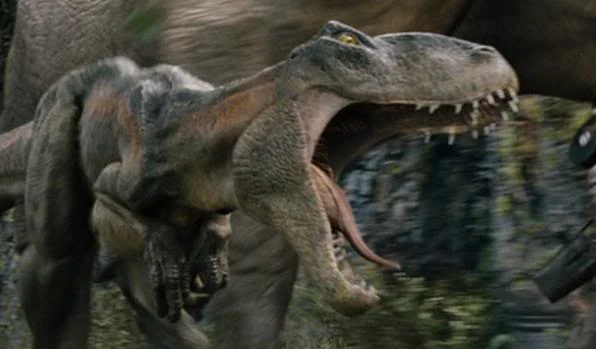
Peter Jackson completely reimaged Skull Island as a complex ecosystem for his remake of King Kong (2005), and he tried to make his dinosaurs stand apart from the ones that had become so well-known in the Jurassic Park franchise. That’s why I’m surprised he neglected to include certain species from the 1933 original like Stegosaurus, Elasmosaurus, and Pteranodon, but decided to instead feature a new fictional species that is clearly copying the Velociraptor from Jurassic. The Venatosaurus is like a dromaeosaurid, with sickle claws, long arms, and great speed, but its skull is much larger and deeper than any real raptor. They ambush a herd of Brontosaurus, causing a stampede, and attack both the long necks and the humans trying to avoid being squished by their massive feet. Even though the pack of Venatosaurus is primarily cgi, there are some practical effects mixed in too, and they look great. This is definitely one of the coolest fictional raptors from any dinosaur film.

If you thought Raptor Island was cool, then maybe you’ll love Planet Raptor (2007). The only thing scarier than an island full of raptors? A whole planet covered in them! This one is right up there (or right down there, rather) in quality with Raptor Island, and unfortunately, is more in-line with the consistency of raptors to be seen for the next decade and beyond.


Dumbass Dromaeosaurs (2010’s-present)


As cgi became cheaper and easier to utilize, more and more crappy dinosaur movies were produced, which led to more and more raptors that looked dumb and acted dumb dominating the direct-to-video market. Even the highest-budgeted dinosaur films of this era tampered with the established ideas that raptors were among the most lethal, terrifying predators in history. Raptor Ranch (2012) A.K.A. The Dinosaur Experiment has some of the worst-looking raptors I’ve ever seen. It makes Carnosaur look like a masterpiece. Age of Dinosaurs (2013) doesn’t have any raptors, but it does have Carnotaurus acting and looking like a raptor, which is embarrassing just on those terms, but the cgi is of the lowest quality, too. One Million B.C. (2008) has got to be the lowest of the low, though, in terms of fake-looking cgi raptors.

Walking With Dinosaurs: The 3D Movie (2013) was a miscalculated attempt to make a family-friendly dinosaur movie with up-to-date science, but they did get it right when it came to the cgi, and the Troodon that is running around the Cretaceous landscape is one of the best-looking dinosaurs of its kind from the early 2010’s. This tiny opportunistic hunter sported the new look that has become commonly accepted by paleontologists as being consistent among all avian dinos: a full-coat of feathers instead of scales. The cgi in Dinosaur Island (2014) might not have been able to live up to Walking With Dinosaurs, but its dromaeosaurs are even more colourfully-feathered than the Troodon, which puts them miles ahead of the Jurassic Park raptors as far as scientific accuracy goes. It’s funny the long-awaited fourth entry in the Jurassic franchise would come out just a year after Dinosaur Island, and be recognized as being comparatively behind the times.

Jurassic World (2015) featured new cloned dinosaurs in a new theme park built on the same island as the original Jurassic Park, but the filmmakers made the choice to maintain those Stan Winston designs instead of redesign the creatures to make them more scientifically accurate. Here’s the problem: when the first Jurassic Park was made, there were no expectations. Steven Spielberg wanted dinosaurs that looked and acted like real animals, not movie monsters. The dinosaurs in Jurassic World are movie monsters. Producers knew those names and classic designs carried enough recognition to inflate box office dollars more than if they made Velociraptor into an accurate turkey-sized animal covered in feathers or kept it the same size and renamed it Deinonychus, so the old outdated looks won out over making something new, but that didn’t surprise me. The movie was designed to cater to those who were nostalgic for the original movie(s) anyway, so we got a pack of raptors that have different colour patterns and maybe a few more bumps, but look exactly the same otherwise. Why not change the name to Deinonychus at least? Oh, right, the name Velociraptor sounds “more dramatic.” Give me a break. And to make matters worse, someone had the bright idea to include a hybrid species, too, called Indominus Rex (not a real dinosaur, for the record), which is revealed to be part raptor despite being even bigger than a T. rex, and therefore it is able to communicate with the pack of raptors later in the movie.

When I first saw the trailer with Chris Pratt riding a motorcycle alongside the raptors as if they were teaming up, I was seriously concerned. It didn’t end up being quite as dumb as everyone thought it might be in the actual movie, but these raptors are still inferior to the ones that came before, in many ways. The whole subplot of trying to train raptors to be used for the military is beyond dumb. For starters, how is a cloned animal ever going to be more effective than a gun or a bomb or other piece of technology? It obviously never will. I guess the idea was the raptors could be trained because they’re so smart, but remember how lethal they were in the original? Having a raptor that will do tricks instead of rip someone’s head off doesn’t make it more interesting for the viewer. I can see what they were going for, trying to ratchet up the tension, never knowing if the raptor might turn on the human leader/the main character, but the concept wasn’t executed all that well—not that it was a great concept to begin with.

I guess I can’t say the Jurassic World raptors are the worst from the 2010’s, because there’s a movie called The VelociPastor (2017) that takes this award home without question. What is a VelociPastor, you ask? Well, it’s a priest who gets cursed to turn into a Velociraptor and fights ninjas. Duh. This brilliantly bad concept for a movie was shot and edited on a budget of only 36,000 bucks, and it shows. Honestly, it’s so perfectly aware of how absurd and cheap it is that it’s a really fun watch, but the raptor is…well, I can’t do it justice. You’ll just have to look for yourself and judge. I'll even do you a favour and post a link to the trailer right here:

https://www.youtube.com/watch?v=7Nyb0GqAjKM

The Velociraptor named Blue returned for Jurassic World: Fallen Kingdom (2018), and my issues with the direction they took the raptors in Jurassic World were compounded. The raptors in the original Jurassic Park made for excellent villains. What can you say: they were clever girls. The raptors in Jurassic World start out as vague threats, then turn into heroes briefly, before turning back into villains because the Indominus Rex told them to, then most of the pack is destroyed and the last survivor, Blue, decides on her own to be a hero and peace out after helping T. rex defeat the Indominus. How sweet the Rex and the raptor made up after their clash in the original movie. In Fallen Kingdom, Blue is like an anti-hero. She’s still sort of threatening, but in the end has to save the humans from the even more threatening Indoraptor: the newest hybrid, which is essentially a smaller Indominus Rex with a black paint job instead of white and more raptor in its genes. The Indoraptor is the quintessential movie monster version of a raptor, which is fine, but it’s so far removed from the well-intentioned Velociraptor of the original Jurassic Park that it characterizes the film in a completely different way. The cgi and practical effects, too, try to be in-line with the original movie, but look utterly inferior.  

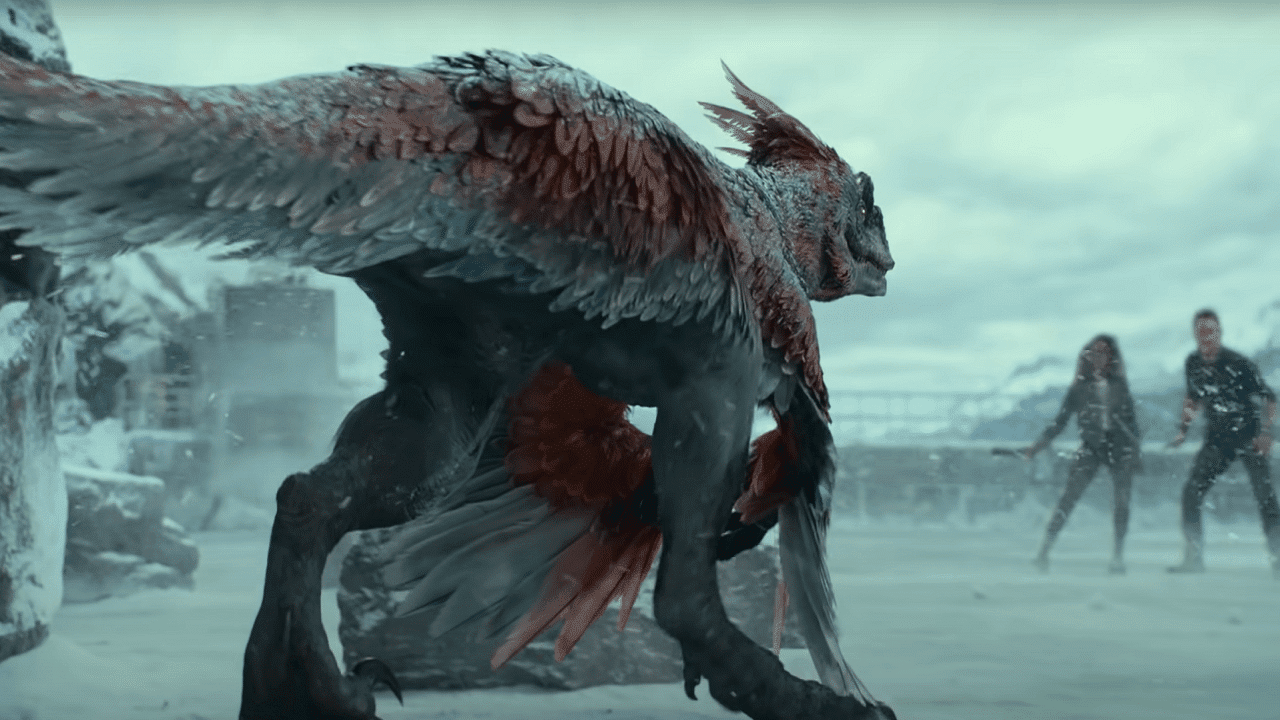
So, in the past few years, raptors have undergone a strange bout of cinematic evolution. They’ve gone from being a scary new dinosaur fad, to oversaturated misrepresentation, and now are either reduced to background cameos like in Aquaman (2018), or made into heroes like in the Jurassic World franchise, which looks to be continuing the trend in Jurassic World: Dominion (2022)—continuing the trend for Blue, at least. New species of raptors will be featured as well, but will they be as fierce as those from the first three Jurassic Park movies? As of writing this, the movie has not been released, so I can’t say just yet. I hope we start to see some more bird-like depictions that keep the names accurate instead of changing them just because of the way they sound. You know what name sounds perfectly badass the way it is? Utahraptor. That dromaeosaur was the largest to ever live, measuring over twenty feet in length and wielding a sickle claw the size of an actual sickle. Put that thing in a dinosaur movie and see how scared audiences get!